 by
by The Broadway Melody won the 1930 Best Picture Oscar, the first sound film to do so. Released only a few years after sound was first introduced into filmmaking, this marked the beginning of a huge movement of musicals for which this era is best known. Films leaned heavily into “talkies” and rapidly explored sound through musical numbers. This film was one of the first to heavily showcase these types of performances.
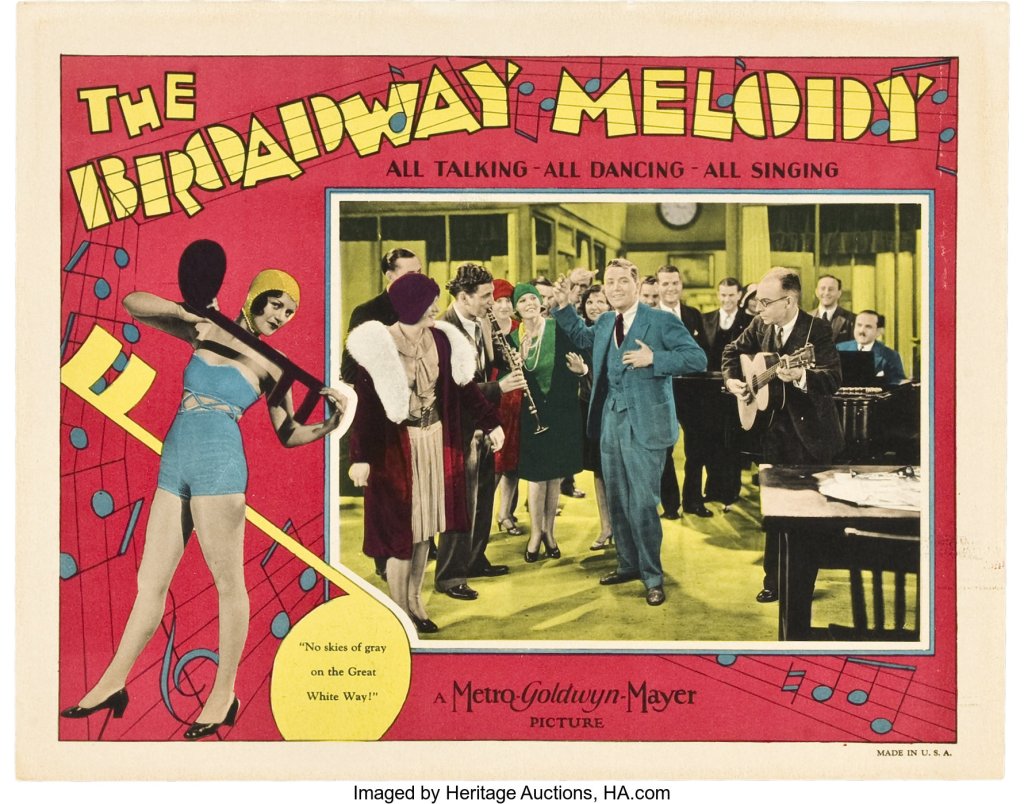
The Broadway Melody stars Bessie Love and Anita Page as two sisters, Hank and Queenie – The Mahoney Sisters, trying to catch their big break and transform from vaudeville performers to Broadway stars. Eddie Kearns, played by Charles King, is engaged to Hank and brings the girls to New York to perform a new song with him in a new production. What follows suit is their struggle to stardom and a sibling love triangle. Though overly dramatic at times, the emotional relationship of the Mahoney sisters is the soul of the film. Bessie Love gives a terrific performance as Hank and received a Best Actress nomination for her efforts.
Still finding its legs as a “talkie”, this film is noticeably loud and full of sound! There are multiple musical numbers that have little to do with the plot and instead exist to only showcase the spectacle and ability of filming singing and dancing. Title and transition cards were still used – a remnant of the silent era – and a silent version of the film was also released, as many cinemas hadn’t yet acquired sound equipment. The film also featured a musical sequence presented in early Technicolor (red and green filters), though no known color prints of the sequence survive.
The film was made “Pre-Code”, before the enforcement of censorship guidelines on what content could be featured in a film, such as profanity, sexuality, and dress codes (these standards were abandoned by the late 1960s, in favor of the now MPAA ratings system.) A lot of films from this era showed female characters in states of undress while backstage in musicals. This is noticed through many points of the film with the girls backstage dressing for each rehearsal and performance, as well as through gay characters.

The Broadway Melody was the top grossing picture of 1929 and a financial success, sparking three more films through MGM with the same name. All of the subsequent films featured Eleanor Powell, and one even starred Fred Astaire. Reviews upon release were primarily positive, but the film hasn’t necessarily withstood the test of time. Interestingly, it is one of only three films to win the Academy Award for Best Picture without winning any other awards.
The film has a 33% rating on Rotten Tomatoes, the lowest of any Best Picture winner.
Nolan
I am a huge fan of films from this era. It’s quite extraordinary to see how quickly musicals evolved and became the defining genre of the next few decades. Fred Astaire and Ginger Rogers ruled this time period with great musicals and dance performances. While watching The Broadway Melody (1929), I couldn’t help but compare it to the exceptional films that followed, like Flying Down to Rio (1933), The Gay Divorcee (1934), and Follow the Fleet (1936).
However, keeping in mind that “talkies” had just barely hit the industry by 1929 and this was one of the first big scale musicals, here are my thoughts:
It seemed to me that this film couldn’t decide whether it wanted to be a full on musical or not. I’m sure at the time they were experimenting with how best to showcase songs and Broadway performances, but a lot of times the music was used sparingly and didn’t really add anything to the film. The way they were shot was odd. Sometimes in an ultra wide shot that cut off the feet of dances mixed into close ups that were focused on the wrong performers, and other times there was only a medium shot that never moved or cut away for an entire song. Even though the music itself was decent, the flatness of the way they were shot took away it’s energy for me. The title song was a nice happy enjoyable tune, but quickly took a backseat. Other numbers, like the “Wedding of the Painted Doll”, though entertaining, were out of place.
The story itself was relatively simple. I did like the close relationship and protectiveness between the two sisters, but it seemed that the biggest conflict could have easily been avoided by just sharing one good conversation. The role of Eddie Kearns was pushy, annoying, and borderline unlikable. Which I suppose is pretty par for the course from this era. I was frustrated watching him try to control and win over Queenie while leaving Hank in the dark about it. He had a few lovely songs in the film, but it was hard to like them, when you know he’s just trying to leave one sister for the other the whole time.
The saving grace for me was the character of Hank. Bessie Love gave a terrifically emotional performance. She had real gumption. She battled to protect her sister even as her own relationship with Eddie was falling apart. It’s a very bittersweet ending for Hank as she watches him fall in love with her sister, and ultimately steps aside just so they can be together.
It certainly was not the worst musical I’ve seen from this era, but over all nothing really stood out to me about the film.
Overall, I’d give it 4/10 stars.
Krissen
It’s always hard to truly understand and appreciate a film out of its context. In 1929, The Broadway Melody was probably a spectacle to behold and groundbreaking. But watching it nearly a century later, it’s hard to ignore the faults.
It’s very clear, very early on in the movie, that productions haven’t quite figured out how to best work with sound on film. This is pre-sound design. Music is played live or played back without thought to leveling and mixing. And the musical numbers included have little to nothing to do with the plot of the movie.
Everything in the film strikes me as cliched, melodramatic, and dated. The only redeeming qualities were that it was from the pre-Code era, meaning there were moments that were saucier and unexpected when thinking about the propriety of older films, and Bessie Love.
Hank is the only character I cared about. Everyone else was extremely unlikeable and the plot was convoluted, messy, and disjointed. The dialogue was cheesy and the cinematography bland as they were still figuring out how to film musical numbers.
All that said, I must admit that I am mostly unfamiliar with films and especially musicals from this time period. And it is likely that The Broadway Melody walked so the more notable films of the era could run.
I give this 4/10 stars.


Two lines into your introduction I had a light bulb moment. I made the immediate connection to the movie Singing In The Rain. Singing In The Rain is all about the transition from silent to talking movies. In the movie Gene Kelly performs a major production number highlighted by the song Broadway Melody. For years I have always had the feeling that this huge production number seemed, in a way, out of place. Now I have a greater understanding as to the context and I will have a greater appreciation for this part of the movie going forward. Thank you for helping me to make this connection.
LikeLiked by 1 person